Hills That Aren't Hills: Ranking London's Artificial High Points
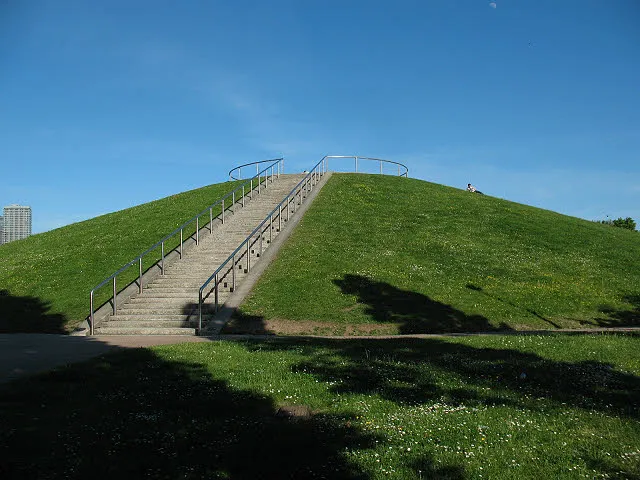
Photo: Stephen Craven, CC BY-SA 2.0, via Wikimedia Commons
London is not a hilly city, and it makes no apologies for it. The highest natural ground inside the boundary is out on the Kent fringes, somewhere most of us will never bother to visit. So if you want elevation in the middle of town, you're largely relying on things people made: spoil heaps, landscaped parks, viewing platforms bolted onto buildings, and one memorable occasion when a council piled up some turf outside Marble Arch and called it an attraction.
I've been up most of them. Here's the ranking, argued entirely on vibe, view quality, and how satisfying it feels to have climbed something that shouldn't exist.
1. Stave Hill, Rotherhithe
This is the one. A rough, scrubby mound in Russia Dock Woodland, built in the 1980s out of material dredged and cleared from the old Surrey Commercial Docks, topped with a bronze relief map of the docks as they used to be. It's only about nine metres high, which sounds laughable until you realise what it's nine metres above: former dock water, now a wooded basin, with the whole Canary Wharf cluster lined up across the river like a wall.
The climb takes about ninety seconds. The view takes considerably longer to get over. Because the surrounding ground is so low and flat, nine metres buys you a surprising amount of separation, and on a clear evening the towers go gold while the woods below go dark. There's a bench at the top, a map to trace with your finger, and usually nobody else. That it's free, unstaffed and open at all hours makes it hard to beat.
2. Beckton Alps
A genuine London oddity. This one is a slag heap — waste from the old Beckton gasworks, piled up until it became the highest point in Newham and, briefly, home to a dry ski slope that opened in 1989 and shut around the turn of the century. The ski infrastructure is long gone; what's left is a grassy, faintly post-apocalyptic hill in the middle of a nature reserve, with the Docklands skyline floating off to the west and the Thames estuary flattening out to the east.
It shouldn't be charming. It is. Go at sunset, take the long way round, and accept that the paths are not always where the map says they are.
3. Queen Elizabeth Olympic Park's north parkland
The landscaped mounds at the northern end of the Olympic Park were designed, not dumped, and it shows. They're gentle, planted, and deliberately arranged to give you a raised look back along the Lea towards the stadium and the Orbit. It's the most polite entry on this list — a hill with a planting scheme — but the payoff is a proper skyline composition, with the stadium bowl, the twisting red steel of the ArcelorMittal Orbit and the Stratford towers stacking up behind each other.
Pair it with a walk along the canals and you've got a full day out that doesn't require a ticket.
4. The raised landscapes of Greenwich Peninsula
The Peninsula has been reworked so heavily that the ground itself is a design decision: elevated walkways, raised parkland, boardwalks over the ecology park, everything nudged up a metre or two to give you a view over the reeds and out across the water. Nothing here is dramatic. Everything here is well judged. The result is a long, low, meandering sort of elevation that lets you see the O2, the river and the towers of Canary Wharf from angles the crowds at the observatory never get.
It's also the best of the bunch for a flat, easy, pushchair-friendly wander, which counts for something on a Sunday.
5. The ArcelorMittal Orbit
The only entry you have to pay for, and the only one where the hill is also the sculpture. Anish Kapoor and Cecil Balmond's 114-metre loop of red steel was built for the 2012 Games and remains the tallest thing in the park; the viewing platform at the top delivers a view of staggering scale, taking in the whole Olympic site, the City, and on a good day the North Downs. The slide down is a separate decision and a separate queue.
It's the most spectacular view on this list and the least satisfying climb, because a lift did the work. That's the only reason it isn't higher.
Honourable mention: the Marble Arch Mound
Built in 2021, mocked relentlessly, closed within months. I maintain that the idea — a temporary hill in the middle of the West End, giving people a free elevated view over Hyde Park — was genuinely good, and that the execution was simply too expensive and too bare. It's gone now. London is poorer for not having tried it again.
How to build a day out of it
Pick two and link them with a walk rather than trying to tick off all five. Stave Hill plus a loop of the old docks is a half-day on its own; Beckton rewards a longer trek and a bit of tolerance for scrub. Check opening times for anything with a lift, take water, and remember that these are hills in name only — trainers will do.
The larger point, though, is that London's constructed high points are a reminder of how the city was made: docks dug, gas burnt, Games staged, ground moved from one place to another. Climb one and you're standing on the city's own leftovers, looking at what it became.