The Tide Sets the Scene: London’s Elevated River-Watching Spots
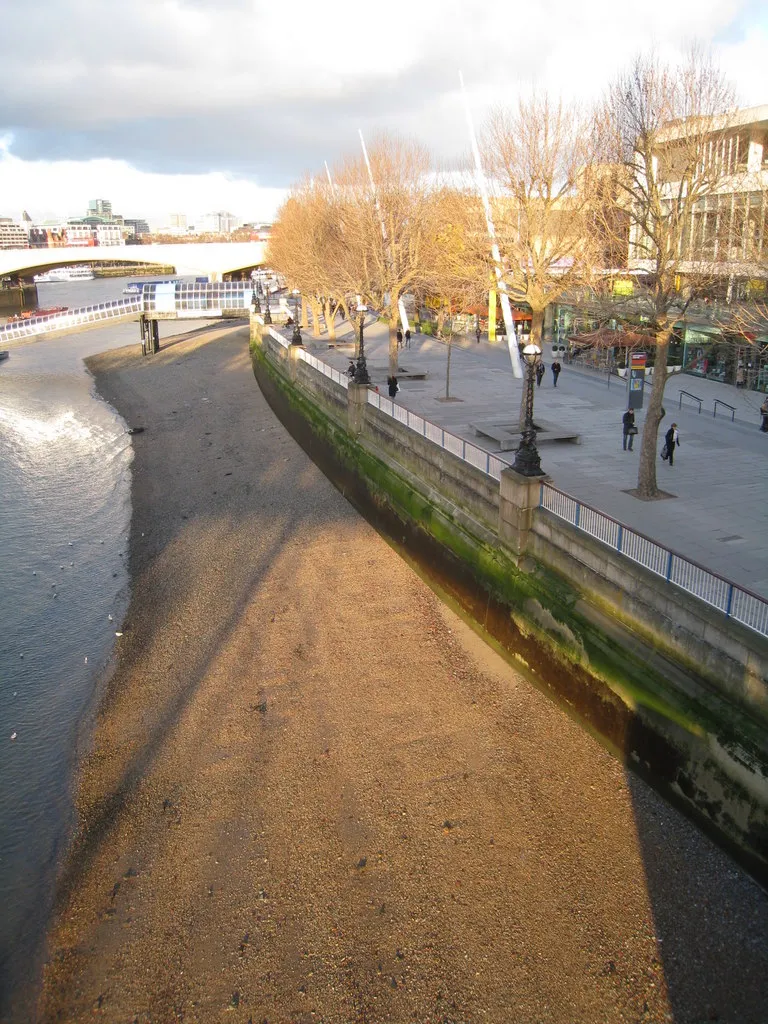
Photo: Sebastian Ballard, CC BY-SA 2.0, via Wikimedia Commons
London from above usually means rooftops, hills and the slow drama of the skyline. Add the Thames and you get a moving part. From a bridge parapet or a high riverside terrace, the tide redraws the view twice a day: mud and stone one hour, a wide brown motorway the next. This is a guide to river-facing high points where the water is the main event, and how to catch the Thames at its most interesting in 2026.
Why the tide matters from above
The tidal Thames rises and falls by several metres in central London. That is enough to change what you are looking at, not just how much water there is. At low tide, the river pulls back to reveal the foreshore — ribs of mud, old timbers, stones, the odd shopping trolley — and the bridges cast long, structural shadows across the exposed bed. At high tide, the channel fills and tightens, boats move faster, and the whole river feels closer to the streets.
You do not need to go down to the foreshore to enjoy this. In fact, the safest and often best way to read the tide is from above. A high pavement, a bridge, a park slope or a free rooftop gives you the pattern without the mud. The trick is to check the tide table before you leave, not after you have climbed somewhere with a view.
Bridge-level perches that reward a second look
Waterloo Bridge is the classic. The wide pavement gives you eastward views to St Paul’s and the City, and westward towards Westminster. At low tide, look down near the South Bank end and you can see the foreshore exposed below, with the bridge’s own shadow cutting across it. At high tide, the same view becomes all surface and movement. It is free, central and easy to combine with a walk along the South Bank.
London Bridge is blunter but just as useful. From the downstream side you get Tower Bridge, HMS Belfast and a long stretch of working river. Low tide exposes the edges near the north bank; high tide makes the channel look busy and full. Millennium Bridge is shorter and busier, but the view back to St Paul’s and across to Tate Modern is hard to beat. Southwark Bridge is the quiet option — high pavement, river on both sides, and enough space to actually stop and look.
Rooftops and terraces with a river frontage
Tate Modern’s viewing level in the Blavatnik Building is free and gives you a proper elevated look at the river, Millennium Bridge and the City. It is not a river-only view, but the Thames is the spine of the scene. At low tide you can often pick out the exposed banks near the bridge; at high tide the water dominates the middle ground. Check opening hours before you go, as they can vary.
On the South Bank, the upper walkways around the Royal Festival Hall and National Theatre give you glimpses and angles rather than a full panorama. They are free, useful for a quick river check, and good for combining with a coffee. If you want something more formal, Tower Bridge’s high-level walkways put you directly above the river — paid, but undeniably river-first.
Further east, Greenwich Park is the big free one. From the slope near the General Wolfe statue you get the classic view over the Old Royal Naval College to the Thames, with the Isle of Dogs beyond. Low tide exposes the muddy edge and makes the river look narrower and more worked; high tide fills the bend and brings the boats closer. It is a proper high walk, and the tide gives you a reason to linger.
Time it right in 2026
Tide times shift by roughly 50 minutes each day, so a good low tide this weekend will not be a good low tide next weekend. Use a proper tide table — the Port of London Authority publishes them, and several tide apps cover London Bridge and Greenwich. Aim for an hour either side of low or high water if you want the clearest contrast. Daylight matters too: in winter, a low tide at 4pm is not much use from a bridge unless you like silhouettes.
Weather changes the picture as well. A windy day makes the high tide look faster and messier; a calm day at low tide gives you cleaner reflections and better shadows. Rain flattens everything, but it also empties the bridges. If you are planning a river-facing walk in 2026, check the tide first, then the weather, then decide whether you want the exposed foreshore or the full channel.
Three pairings for a river day out
Start with Waterloo Bridge at low tide, then walk the South Bank and finish at Tate Modern’s viewing level for the elevated version. Or take Greenwich Park at high tide, when the river is full and the boats are moving, then drop down to the riverside path. A third option is Rotherhithe: Stave Hill gives you a free artificial summit with Canary Wharf and the river in the distance, and the nearby streets have a quieter, working-river feel.
The quiet pleasure of a moving view
A skyline is mostly fixed. The Thames is not. That is why river-facing high points are worth revisiting: the same bridge, the same terrace, the same park slope can look like two different places depending on the water. You do not need a ticket or a clear blue sky. You just need to know when the tide turns, and to look down as well as out.